Pages

Tuesday, June 7, 2011

NZ “Not As Squeaky Clean As People May Perceive”

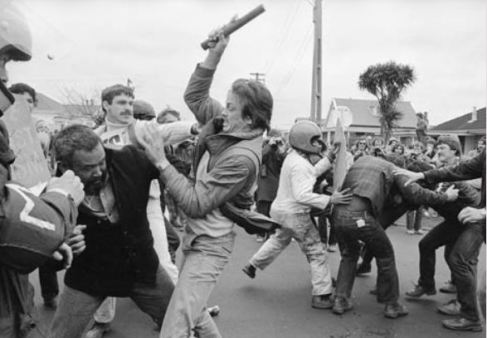
 1981 Springbok tour, dark days for NZ

The Rugby World Cup is very likely to become a focus for civil disobedience among NZ protest groups who are threatening civil disobedience and the flour bombing of matches.

“…Groups protesting against Government economic policies are proposing “civil disobedience” to disrupt the Rugby World Cup – possibly including flour-bombing Eden Park.

The protesters, including unions and church groups, plan to march up Queen St in Auckland from noon tomorrow against last week’s Budget cuts to KiwiSaver, family tax credits and public services and state asset sales.

Spokesman Meredydd Barrar of the newly formed Coalition for Social Justice said the groups also “intend to take action during the World Cup to alert the world that New Zealand is not as squeaky clean as people might perceive. We might have to flour-bomb Eden Park again,” he said.

Anti-apartheid protesters famously dropped bags of flour over the stadium from a plane during the final test of the Springbok rugby tour in 1981…” read the rest in The Herald

During the 1981 Springbok tour ("The Flour Bomb Test") Eden Park was peppered with flour bombs and flares dropped from a low flying Cessna. All Black prop Gary Knight was knocked to the ground by a flour bomb. Outside the ground violence erupted on a grand scale.

[youtube=http://www.youtube.com/watch?v=rkZMIySG75c]

In Hamilton the match against Waikato was called off in front of a full house after a pitch invasion by several hundred anti-tour protestors, and rumours that a light aircraft had been stolen from Taupo and was headed for Rugby Park. (source)

New Zealand Exposed

Among the people threatening to disrupt the tournament are Maori activists Titewhai Harawira and Ngaire Te Hira. In February they announced they were going to use the Rugby World Cup to "expose" New Zealand's treatment of Maori.

Titewhai Harawira was reported as saying

"We are going to use the international media to expose what is going on in this country," she told the Sunday Star-Times.

"I want to be telling international media that all those reports they get that say we are well looked after and our land is intact are rubbish. We are going to be talking to the international media, absolutely."

Harawira said she hoped to provide visitors with a "whole chronology of what has happened in this country".

"I will talk about how legislation has taken away and denied us," she said. "We have time to put it all together, hand it out and talk about it." read more here

Unite Union is running a campaign for a $15 an hour ($12 US) minimum wage and is says it "plans to use activities around the Rugby World Cup to press hard for the significant increase in the minimum wage."

Of course getting the truth out about New Zealand is nothing new.

There are people who have been exposing the truth about New Zealand for many years. A group of expatriates set up a website called Expatexposed.com to draw attention to the raw deals that migrants get in New Zealand. Many of its members were taken-in by misleading marketing and the promises of work and higher living standards that never materialised.

You may also be interested in

Adios, No Mexican Wave For English Fans At Dunedin RWC Matches - "The Mexican Wave is going to be banned at all RWC matches at Dunedin’s soon to be completed 30,000 seat stadium..."

Eden Park Four Nations – “Disgraceful” Behaviour Slammed - "Alcohol fuelled mayhem at last night’s Four Nation’s match at Eden Park. Read Drunken fans marr Eden Park’s Four Nations..."

“NZ: 100% Pure Rip-Off” - "Oh dear, bet the guys who coined the “100% Pure NZ” are cringing right now. It will be interesting to see how well the brand’s image survives this latest onslaught on the slogan that lends itself so easily to abuse. It is currently being used to highlight how expensive New Zealand has become. It all started with an article in the NZ Herald under the header “NZ: 100% Pure Rip-off. Rip off New Zealand?” written by Peter Bills, an international writer for Independent News & Media."

Our very popular Migrants Tales series and NZ Facts and Stats pages

Today's posts - click here

Wednesday, June 1, 2011

NZ ‘Great Place To Raise Kids,’ Not So Great For Teens

Various media outlets are today carrying a story about the release of a new report from the Prime Minister’s chief science adviser, Sir Peter Gluckman, called Improving the Transition. Reducing Social and Psychological Morbidity During Adolescence.
This is how Stuff started its coverage of the report
NZ teens at ‘unprecedented risk’ – report
Adolescents growing up in New Zealand have to navigate a gauntlet of dangers that are putting them at unprecedented risk, a major Government report says.
The report from the Prime Minister’s chief science adviser, Sir Peter Gluckman, says one in five young New Zealanders will face problems as they grow up that will affect the rest of their lives.
Alcohol, depression, drugs, bullying and earlier sexual development are among the issues singled out in the report, which was authored by two dozen leading researchers… read more
You can read a full copy of the report here and we’ve included the executive summary from it below.
Great Place To Raise Kids
Still thinking about moving to New Zealand because you’ve heard it’s a great place to raise kids?
You may want to start by reading our Stats and Facts page about Education and Children’s Issues in New Zealand. This is the first section from that page:
“Aotearoa/ New Zealand has;
  • A problem with gangs that are contributing to crime and abuse in the home. Young people are joining gangs for safety and are becoming victims of gang life.
  • A problem with bullying – particularly of specific groups like refugee and migrant young people.
  • A problem with child abuse which is not just statistics or features in death notices in newspapers but a reality that many of the young story tellers knew and experienced.
  • An issue with domestic violence affecting the lives of many children and young people.
          quote from “HEAR OUR VOICES” by  Save the Children, NZ:
Despite statements like the above by Save the Children,  New Zealand is often presented to migrants as a great place to bring up the kids. Is this Marketing hype or just wishful thinking on the part of migrants trying to justify their decisions to leave?
Are you going from frying pan to fire?
It sounds patronising, but sometimes I feel sorry for New Zealand. We’re a curious anomaly. One day the country is rated as one of the best places in the world to live, most peaceful, best quality of life, best cities to visit, best coastline, best leisure sports. For such a small population, we do incredibly well at certain things and appear, from the outside, to be at one with the environment. Yet, at the same time, there’s high teen suicide and pregnancy rates, high alcohol consumption, high rates of bullying, domestic violence and child abuse.
If New Zealand is such a fabulous place to live, why are we leaving?…” read more on MSN Money NZ
Teens
The Chief Coroner said he was “shocked and frustrated” by the high number of very young teens (some as young as 13) who drink themselves to death in New Zealand. It’s another symptom of the country’s hard drinking/binge drinking culture.

How would you feel if you found out that your daughter;s school was offering her nicotine patches and other quit smoking products to her and her classmates to wean them off cigarettes. Would you want to be consulted beforehand?


Woud you still move knowing that New Zealand has some of the highest rates of child abuse, teen pregnancy and youth suicide in the world?

How do feel about New Zealand’s problems with youth violence,  human rights abuses in its schools, a bullying culture, the low quality of education and host of other problems including high incidences of diseases more usually associated with developing countries?

Have you thought about your child’s future as they become an adult in New Zealand, will there be sufficient work for them and will they have to leave to have a reasonable chance of a bright future?”
Read more from our facts and stats page

Improving the Transition. Reducing Social and Psychological Morbidity During Adolescence. (Emphasis ours)
Executive summary
Adolescents in New Zealand relative to those in other developed countries have a high rate of social morbidity. While most adolescents are resilient to the complexities of the social milieu in which they live, at least 20% of young New Zealanders will exhibit behaviours and emotions or have experiences that lead to long-term consequences affecting the rest of their lives.
  •  An extensive and unbiased review of the relevant scientific literature has been undertaken by a multidisciplinary panel of experts. The key points are summarised in this introductory Synthesis Report, and the main part of the report contains the detailed and domain-specific reviews.

One dominant message comes through – that application of the international and domestic evidence base to policy formation and programme development in this area will lead to better outcomes for our young people. However, to do so will require a prolonged effort over several electoral cycles and cannot be held hostage to adversarial politics. Our research suggests that many programmes have been introduced, albeit with good intent, that are unlikely to succeed as they are not supported by the evidence base, whereas other approaches likely to be effective have not been implemented. A key challenge is to ensure that all programmes are appropriately monitored to ensure that they are effective and cost effective within the New Zealand context, allowing better use of scarce public resources to support our young people.

• Adolescence is now a prolonged period in the human life course. Its length is influenced by the declining age of puberty as child health has improved and by the rising age at which young people are accepted as adults. This has both societal and biological elements, the latter reflecting recent findings that brain maturation is not complete until well into the third decade of life and that the last functions to mature are those of impulse control and judgement. It is therefore inevitable that adolescence is a period of risk-taking and impulsivity. For many children these are basically healthy and transient behaviours, but for too many there are long-term negative consequences. The key issue is what can be done to change the nature of, and reduce the impact of, these behaviours.

• The evidence shows that the risk of impulsive and antisocial behaviour is greatly increased by experiences earlier in life. It is now clear that early childhood is the critical period in which executive functions such as the fundamentals of self-control are established. Children who do not adequately develop these executive functions in early life are more likely to make poor decisions during adolescence, given the inevitable exposures to risk in the teenage years. It is very clear from our review of the literature that more can be done to improve socialisation and executive function development by reorientation of early childhood programmes. Further, while all children will benefit from these programmes, the evidence is compelling that targeting intensive but costly interventions towards the higher-risk sections of the community has a high rate of social and economic return. Hence the critical importance of adopting a life-course approach to prevention.

• Remediation in adolescence is not likely to be as effective as prevention. Although there are some remediation programmes that are partially effective, others clearly are not. Public and voluntary investment in programmes directed towards at-risk adolescents needs to be re-orientated towards those interventions that can be shown by high quality research to have real impact within the New Zealand context.

• The adolescent brain is clearly more sensitive to both alcohol and cannabis, with long-lasting adverse consequences for far too many. Stronger measures are needed to restrict access of young people to these drugs.
One cannot overestimate the changed nature of the social environment in which young people find themselves compared with that of previous generations. The nature of peer pressure and role models has been radically altered by exposure to electronically connected social networks and to very different media content. Young people have far greater freedom, engendered by more ready access to funds. While the exact impact of these changes is difficult to ascertain, it is clear that they have radically affected the social pressures that influence adolescent behaviour. This creates challenges for parents and society in establishing boundaries and acceptable behaviours.

A significant proportion of young people suffer from depression and other mental health disorders, yet the range of services available to them is inadequate. Given New Zealand’s high rate of adolescent suicide and psychological morbidity we suggest that priority be given to addressing this capacity gap and to raising public awareness of the particularities of adolescent depression.

• In general, most of the risky and impulsive behaviours of adolescence reflect incomplete maturation of self-control and judgement. Accordingly, punitive approaches are less likely to be effective than well-established and validated approaches that attempt to remedy these deficits. There is an inherent conflict between the practical focus on using chronological age to determine rights and obligations and the highly individualistic processes of maturation.

• The young people of New Zealand reflect the changing ethnic mix of our population. While the issues and their solutions are generic across all of our population, programmes must be developed and delivered in culturally appropriate ways to the very different communities that now make up young New Zealand. Targeted investments in the ‘long tail’ of educational underachievement and social disengagement will be needed. It is clear that while adolescent morbidity is observed across the whole of our communities, it is disproportionately found within sectors where there is intergenerational disadvantage.
• Social investment in New Zealand should take more account of the growing evidence that prevention and intervention strategies applied early in life are more effective in altering outcomes and reap more economic returns over the life course than do strategies applied later. This will require long-term commitment to appropriate policies and programmes.
Synthesis Report

• The report identifies a number of knowledge gaps that should be addressed.

Today's posts - click here

LinkWithin

Related Posts with Thumbnails